Showing posts with label Hilda of Whitby. Show all posts

Monday, November 18, 2019

St Hilda of Whitby

Because her feast day is on my birthday, I always take joy in her remembrance on this day. She encouraged a young poet to sing his songs, and her spirit of encouragement, her "grace-of-being," calls out even today. ~ CK


Image of St. Hilda
from Caedmon's Cross
For Hilda of Whitby

In a simpler time
Of kingdoms and and fiefdoms
When liege lords and princes
Set their boundaries across the land,
Killing one another for the right to rule,
A lady arose
Who called for a higher vision.

She established at Whitby
A spiritual path,
A community of grace
For both men and women
Who sought love and life
Rather than power and death.
Learning was foremost
In a setting where
The arts
The sciences
And sacred texts
Were all studied
And held in high esteem.

Hilda became advisor to kings,
Counselor to bishops,
Encourager of poets,
Mediator in religious controversy.
King Edwin
Bishop Wilfrid
Caedmon
The Synod of Whitby
All give her thanks.

Honored as a saint
By Rome and Canterbury alike,
Followers of Celtic spirituality
Pay their respect
To the Abbess of Whitby.

The hildoceras ammonite*,
Named for the saint from Yorkshire
Connects her name
To eons past.
Thus her grace-of-being
Extends to both past and present
As Hilda of Whitby
Is remembered on this day.


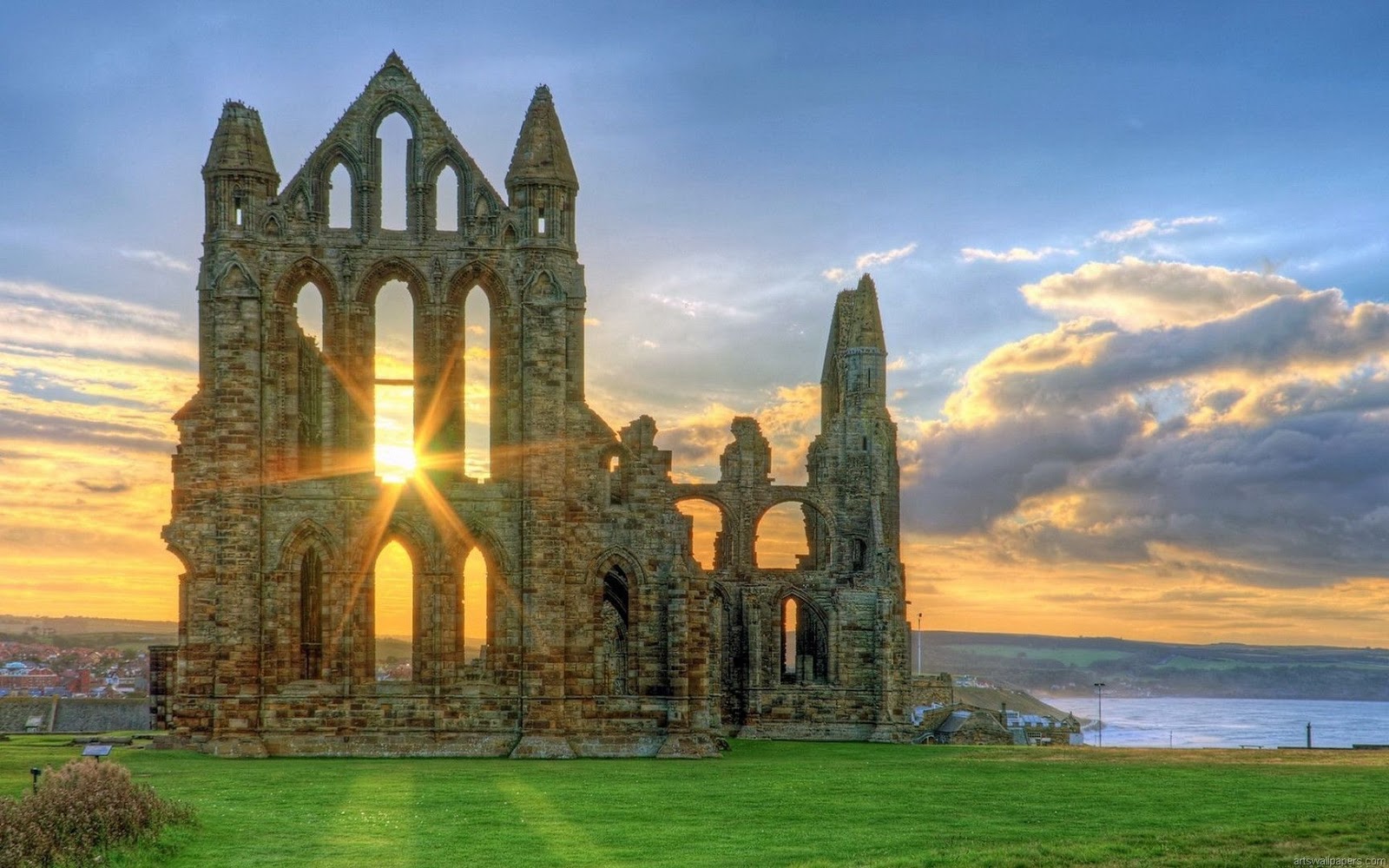
The ruins of the present abbey reputably near the site where Hilda had her first monastery Streonashalh on the headland at Whitby. The present ruins are from an abbey built by the Norman knight Reinfrid in 1070s which was rebuilt in 1220s. (From the Parish Church of St. Wilfrid website)


Hildoceras Bifrons ammonite
Early Jurassic Period

*From Wikipedia: The genus name has been given the name Hildoceras in honour of St. Hilda of Whitby (614-680 AD). Legend has it that this lady was required to found an abbey on the cliffs above Whitby, in the north of England. Finding the site to be infested by snakes (a devilish omen), she prayed to the Lord and the snakes coiled up and were turned to stone. She picked them up and threw them over the cliff, and that is why there are so many ammonite fossils in the rocks below the abbey. The specific name bifrons comes from Bifron, a demon, another name for the Roman god, Janus


For Further Reading: 


-

Saturday, November 18, 2017

Saturday Haiku: Distant Songs

sometimes a ruin
calls to that place of turning
to hear distant songs


_____________

Photo: Ruins of Whitby Abby
Source: Earth Spotter

The 12th century abbey was built on the site of the 7th century monastery where Hilda was abbess when she encouraged Caedmon, the first English poet. The feast day for St. Hilda of Whitby is November 18.


-

Wednesday, November 15, 2017

The Windows of St. David's Church

(Logo for St.David's Episcopal Church
Denton, Texas)
Many years ago, I happened upon a photocopy of an article from The Living Church. “A Literary Succession,” by Edward Rutland told about a unique set of four windows at the St. David of Wales Episcopal Church in Denton, Texas. The windows “honor four saintly persons who contributed in different ways to English literature.” The saintly persons celebrated are Hilda of Whitby, The Venerable Bede, John Donne, and C.S. Lewis.

Having majored in English Literature in college, and since I was involved in social services at an Episcopal Church at the time, the article caught my interest. One thing that amazed me was in learning about Hilda of Whitby and her encouragement of Caedmon, the first English poet. In my English Lit studies, I had felt a connection with Caedmon since high school days. The fact that he was a shy person who loved music and became inspired to write songs of beauty gave me hope. I read in Rutland's article how Hilda had been the encourager of Caedmon. The astounding part, after being drawn in to learn about Hilda of Whitby, was to discover that her feast day is on my birthday! I had just found a new patron saint.

Searching for the Windows

Last year, I began searching for photos of the windows at St. David’s Church. I was only able to find one of them online, but I wanted to view them all and I didn’t have any plans to travel to Texas. I sent an email to the church when I found their website and asked if any photos of the church windows were available. The rector, Canon H.W. Herrmann, graciously emailed me four beautiful photos of the windows.

I am sharing those photos here, along with text from the article* by Edward Rutland in which he gives a brief sketch of each life depicted in the windows.  As the article states, “Four companion windows in St. David's Church, Denton, Texas, indicate the history and variety of literature and learning in Anglicanism.”


St. Hilda of Whitby


St. Hilda of Whitby (614-680) is included because she was both a woman in the decision-making processes of the early church (important in the city which includes the main campus of Texas Woman's University) and because she is a person of literary significance not to be forgotten. She is shown with the pastoral staff of her abbotship and holding a small church, representing her simple monastic settlement and its successful school.

She is noted for her Celtic sympathies but cooperative spirit at the Synod of Whitby (664). And she is appreciated for the literary and spiritual sensitivity with which she sponsored a rustic farmhand named Caedmon. Her encouragement helped him produce for his own Anglo-Saxon people vernacular poetry on Christian themes. Though his poems, done in bardic manner, were mostly lost in antiquity, they place him at the head of the long line of English poets. Honored as a saint according to early Celtic custom, her day in the Christian calendar is Nov. 18.


The Venerable Bede


The Venerable Bede (c. 673-735) said “study, teaching, and writing have always been my delight.” Indeed, his writings are wide ranging in subject matter, and vast in number, including 25 words of scriptural commentary, translations, treatises on grammar, poetics and calendar reform, plus biographies and more. He is said to have been the first known writer of English prose, though his vernacular prose texts have been lost.

A hint of his piety may be found in two of his poems set to music in the Episcopal Church's Hymnal 1982. But it is as “the first English historian” that he is generally known. His Ecclesiastical History of the English People, written in Latin, often translated, is still valued by scholars for being authoritative historiography according to 20th century criteria.

His attire identifies him as a “monk of Jarrow,” as he is often called, for it was there that he did his life's work. But in the 11th century his remains were moved to Durham, and in 1370 were relocated to their present location, now a lovely shrine, in that cathedral. The day of his commemoration has been changed several times; since 1969 it has been May 25.


John Donne


John Donne (c. 1572-1631) “No man is an island” - with such nautical analogies Donne spoke to the sea-faring people of England when he was dean of St. Paul's Cathedral, London. His writings are daunting if he is not identified at the outset as a multifaceted personality of genuine Renaissance proportions. (In the window he is shown in the garb of period, except that the dean's cassock is of a later date.)

Much is known of him through Izaak Walton's Life, through Ben Johnson's observations, through the erudite and often poetic correspondence which he exchanged with others, through their memorializations of him, but most notably through the autobiographical character of his writings.

To those who through his writings know him and perhaps love him, he is fascinating, exasperating and inspiring. He is a mixture of the sensuous, secular and worldly, and the intellectual, pensive and devotional.

Though in early adulthood a spendthrift who lived in respectable poverty, he was widely traveled and a man of immense learning. In both poetry and prose his language is in the style of the times: figurative, evocative and metaphorical - often in the extreme. His friend Ben Johnson reckoned that, as a result, his writings would perish. Happily T.S. Eliot regarded him as being in the direct current of English poetry. In his polemics he was careful to place himself in the theological mid-road of Anglicanism.

John Donne, priest, is one of the "worthies" added in recent years to the calendar of the prayer book in this country: March 31.


C.S. Lewis


C.S. Lewis - Seven days short of the 65th birthday, and in failing health, C.S. Lewis died quietly at home Nov. 22, 1963. Since his home parish, Holy Trinity, Huntington Quarry, is on the outskirts of Oxford, he often went to confession and communion at the Church of St. Mary Magdalen, a high church parish in the heart of the university city that was the center of Lewis's life. Now, nearly a third of a century afterward, the world knows him better, and loves him more, than in 1963.

He was one of a remarkable group of 20th-century lay people - G.K. Chesterton, Dorothy Sayers, T. S. Eliot and W. H. Auden, to name a few. In an age of unfaith, cynicism, moral disorder and strange spiritual searchings, Lewis is read and admired by all sorts and conditions of people - the young, the old, from sacramentalists to fundamentalists, and beyond!

Born an Anglican, Lewis lost his faith during his teen years. In his maturity he knew the other side, the side of unfaith, its viewpoints and arguments. That perspective adds richness to his writings, and charm saving him from pedantry.

Because he popularized serious concepts, Time called him an “amateur theologian.” Chad Walsh, in the New York Times Book Review, said Lewis had “the ability to make Christian orthodoxy exciting and fit for the brave rebel.” His creed was stated in Mere Christianity: “the belief that has been common to nearly all Christians at all times.”

That he was sharply aware of humankind's sinfulness is seen in such works as The Great Divorce. In The Screwtape Letters, he deployed humor to disclose the wiles of the Devil. He wrote straightforward apologetics in The Problem of Pain, a luminous book to be read alongside Letters to Malcolm. And he did a very readable "word study" of biblical terms in The Four Loves.

_________________________

Photos of the windows at St. David's Church were sent by the Reverend Canon H.W. Herrmann, SSC, rector of St. David of Wales Episcopal Church, Denton,TX


*"A Literary Succession" by Edward C. Rutland, The Living Church, May 14, 1995, vol. 210, no.20, p. 12-13. (archived at https://episcopalarchives.org/cgi-bin/the_living_church/TLCarticle.pl?volume=210&issue=20&article_id=2) 


-

Wednesday, November 18, 2015

On the Feast Day of St. Hilda of Whitby

Image of St. Hilda
from Caedmon's Cross
For Hilda of Whitby

In a simpler time
Of kingdoms and and fiefdoms
When liege lords and princes
Set their boundaries across the land,
Killing one another for the right to rule,
A lady arose
Who called for a higher vision.

She established at Whitby
A spiritual path,
A community of grace
For both men and women
Who sought love and life
Rather than power and death.
Learning was foremost
In a setting where
The arts
The sciences
And sacred texts
Were all studied
And held in high esteem.

Hilda became advisor to kings,
Counselor to bishops,
Encourager of poets,
Mediator in religious controversy.
King Edwin
Bishop Wilfrid
Caedmon
The Synod of Whitby
All give her thanks.

Honored as a saint
By Rome and Canterbury alike,
Followers of Celtic spirituality
Pay their respect
To the Abbess of Whitby.

The hildoceras ammonite*,
Named for the saint from Yorkshire
Connects her name
To eons past.
Thus her grace-of-being
Extends to both past and present
As Hilda of Whitby
Is remembered on this day.


The ruins of the present abbey reputably near the site where Hilda had her first monastery Streonashalh on the headland at Whitby. The present ruins are from an abbey built by the Norman knight Reinfrid in 1070s which was rebuilt in 1220s. (From the Parish Church of St. Wilfrid website)


Hildoceras Bifrons ammonite
Early Jurassic Period

*From Wikipedia: The genus name has been given the name Hildoceras in honour of St. Hilda of Whitby (614-680 AD). Legend has it that this lady was required to found an abbey on the cliffs above Whitby, in the north of England. Finding the site to be infested by snakes (a devilish omen), she prayed to the Lord and the snakes coiled up and were turned to stone. She picked them up and threw them over the cliff, and that is why there are so many ammonite fossils in the rocks below the abbey. The specific name bifrons comes from Bifron, a demon, another name for the Roman god, Janus


For Further Reading: 


-

Monday, November 18, 2013

Hilda of Whitby

The ruins of Whitby Abby, founded by St. Hilda

Hilda of Whitby, born in 614 in Northumbria, was a spiritual leader, abbess at the monastery at Whitby, and advisor to kings and commoners. Her preferred practice was centered in Celtic Christianity, though she brokered a peaceful transition when at the Council of Whitby, King Oswy decided to bring Northubria in line with Roman tradition. She also nurtured and encouraged a stable hand named Caedmon to sing his songs in his native Anglo-Saxon, thus she assisted in bringing forth the first English poet.

St. Hilda’s feast day is November 17 in the Roman Catholic Church, but in the Episcopal Church her day is celebrated on my birthday, November 18 – which is why on this day I am more Anglican than Catholic. I take some time on this day to honor the Celtic heritage, feminine leadership, and the poetic voice.

Read more at:


-

Tuesday, January 26, 2010

Cattle Call: A Tribute to Cowboys, Poets, and Other Wanderers


[Okay – I wasn’t really there. I just got so caught up in listening to the CD Emmylou Harris At the Ryman that I wrote this piece as though I were recalling the live performance.]


Emmylou Harris was at the Ryman. There was joy that night – and celebration. There were songs of elation and songs of regret; songs of work and songs of wistful longing. There was Bill Monroe before he died. Every seat was filled. There were beauticians and mechanics; miners and factory workers; carpenters and teachers. It was an audience of regular folks, out on a Saturday night. I had been fascinated by Emmylou Harris since my college days. I don’t know whether it was that clear voice that could simultaneously convey joy and longing, or if it was those eyes and the long, dark hair. Maybe it was the way she moved and carried herself; maybe it was some trait that resonated with my own anima (that creative feminine aspect of the inner self). At any rate, when she would sing, I would listen.

We heard bluegrass numbers and some folk-rock, but when she sang Tex Owens’ Cattle Call, my mind went back to another day. I remembered a day when I was 8 years old and we still had county fairs. Back then we could see prize livestock gathered in the cow barn during the fair, and once my Dad even gave me 50 cents to buy a chance on a beautiful black and white calf. I reminisced further and thought of drives in the countryside where the cattle outnumbered the people. There were visions of barbed wire fences, pastures, creeks, and salt licks.

Hearing the beautiful yodel in Cattle Call as the song continued, I went further back to an earlier day. I thought of that era of westward expansion and cattle drives when the cowboy came into his own as a symbol of rugged independence, idealized in film and rodeo. I wondered if little boys still want to be cowboys the way we did when we watched those Saturday matinees.

Then Emmylou came back to the chorus with the melodic call, and I went still further back to cattlemen of a different era. I thought of that cattleman from long ago who rode the plains of Whitby, England, back in the seventh century. Herding cattle by day and sitting in the mead hall by night, the song finally came to Caedmon. He first captured my heart and imagination in a high school literature class where I heard about that earliest of English poets. Caedmon was a cowherd who loved song, but was too bashful to pick up the harp and sing in the mead hall. Then a lady appeared to him in a vision and told him to sing of the beginning of things. From that day on, Caedmon sang songs of uncommon beauty, inspired by the lady in his dream. She must have looked and sounded a lot like Emmylou Harris.

I was captured by that story of Caedmon because even though I loved the song and was inspired by words, I was also painfully shy and seized by stage fright. I thought, if Caedmon was a cowboy, then perhaps I could be one, too. Caedmon was encouraged by Hilda of Whitby, leader of the local abbey. Later recognized as a saint, Hilda was a champion for poets and the Celtic way. She was an advocate for those early Englishmen and Celtic cowboys as the Latin world was forcing assimilation. She was the great mediator at the Council of Whitby to temper the Latin religious onslaught. Hilda remained a supporter of Caedmon and his non-Latin song. She must have looked and sounded a lot like Emmylou Harris.

Imagine my wonderful surprise when I learned that the American Book of Common Prayer honors the feast of St. Hilda is on my own birthday, November 18. Now each year on the anniversary of my birth, I think of saints and poets and cowboys.

The wafting of Cattle Call returned with the final chorus. The whole audience was enthralled. I could keep going back in time to other cowboys. Father Abraham was a cattleman as well, you know (he has been revered down through the years by all kinds of cowpokes who had names like Roy, and Schlomo, and Achmed). Abe left his homeland and drove his herds along the plains and valleys of Canaan. I don’t know who inspired him most, whether it was Sarah or Hagar, or the Almighty, (tradition indicates the latter) but whoever it was, she must have looked and sounded a lot like Emmylou Harris.


***