Showing posts with label social change. Show all posts

Monday, March 16, 2020

Songs of Social Consciousness: Blowin' in the Wind (Peter, Paul & Mary)

The folk music scene of the 1950s and early 1960s became a burgeoning conduit for social awareness and calls for change. Bob Dylan was one songwriter who tapped into that growing consciousness and the folk group, Peter, Paul & Mary helped to carry that awareness in concerts and on the airwaves.


From the YouTube notes:

"Blowin' in the Wind" is a song written by Bob Dylan in 1962 and released on his album The Freewheelin' Bob Dylan in 1963. Although it has been described as a protest song, it poses a series of rhetorical questions about peace, war and freedom. The refrain "The answer, my friend, is blowin' in the wind" has been described[by whom?] as "impenetrably ambiguous: either the answer is so obvious it is right in your face, or the answer is as intangible as the wind". In 1999, the song was inducted into the Grammy Hall of Fame. In 2004, it was ranked #14 on Rolling Stone magazine's list of the "500 Greatest Songs of All Time".

-

Wednesday, October 3, 2018

The Feminine Voice in a Pivotal Age

The "silence breakers" of the Me Too Campaign
named Time Magazine's Person of the Year
I believe we are living in a pivotal age, meaning that humanity is at one of those historical crossroads.  The old institutions are not serving as effectively as in the past and we have not yet figured out what social structures will best serve us in our current time, not to mention in the years ahead. Pivotal times are never easy.  They are marked by unrest with some clinging to the past, others pressing for change, and few with adequate insight to see how to navigate the shoals of change.

The good news is that pivotal ages are times of rebirth for society. They are times when humanity can emerge from the chrysalis that held it for a time to find a new day of of promise. The hard truth for those who happen to be living in pivotal age is that they will not see the full benefit that is yet to come.

Pivotal times are borne out today in that we are seeing the struggle of our emerging from that chrysalis of outdated structures (St. Paul called it labor pains that precede the birth of a new world). There is a new awareness arising that will ultimately guide us to a healthier way of living. Two big examples of that awareness are (1society's insistence that we address the plight of child abuse and (2) the call to end men's violence against women.


In our lifetime, we may not see the full fruition. We may have to content ourselves with living in hope that the new day will dawn. In the meantime, we must not grow weary in our efforts toward the greater common good. To that end, I am re-posting an essay from September 2015 about Hildegard of Bingen.

Hildegard was a true visionary during a pivotal age. She lived from 1098 to 1179. I offer this brief recollection in celebration of that feminine voice that is emerging today as we find ourselves once again on the cusp of change. 

Hildegard of Bingen: Wellspring of Creativity


Hildegard of Bingen (Feast Day, September 17) is sometimes referred to as the patron saint of creativity. She has also been known as the patron saint of the culinary arts, having written many recipes including her "Cookies of Joy" recipe for "reducing bad humors" and "fortifying the nerves." Actually, she is not an official patron saint of anything, which may be a good thing because to think of Hildegard merely as a “patron saint” is to gloss over her profound capabilities and influence.

Hildegard of Bingen was a polymath  an individual highly gifted in a variety of fields. She was skilled in the healing arts, having written two books on pharmaceutical herbs and the workings of the body. Her written works include theology, ethics, and biblical commentary. In addition, she composed music and wrote poetry. She was a visionary who brought religion, science, and art together.

St. Hildegard has a wide range of admirers today. She was recently been named a Doctor of the Church by Pope Benedict XVI (there are only 35 Doctors of the Church to date, and only four women). She is also of interest to feminist scholars and many in the New Age movement.  She claimed her knowledge came from divine visionary experiences, which may have lent credence to her words at a time when women had little voice. She challenged institutional corruption in the church and spoke out for social justice. There is even renewed interest in Hildegard’s music, with several modern recordings featuring her works.

A Pivotal Age

The Twelfth Century was a very dynamic period and St. Hildegard was right there in the thick of it, having lived from 1098 to 1179. Indeed, it was a pivotal time of shaking off many of the old ways and taking up new forms. Perhaps it is no wonder that the saint from Bingen is attracting more attention in our day when old forms are not working and our institutions which were developed during the Industrial Revolution are languishing and becoming ineffectual.

One example of how Hildegard’s understanding grew and developed as a result of her visionary mystical experiences is seen in the following quote in which she describes one of her visions:

"Listen: there was once a king sitting on his throne. Around Him stood great and wonderfully beautiful columns ornamented with ivory, bearing the banners of the king with great honor. Then it pleased the king to raise a small feather from the ground, and he commanded it to fly. The feather flew, not because of anything in itself but because the air bore it along. Thus am I, a feather on the breath of God."

May we all come to see ourselves being borne up and empowered by the very breath of God. For people who want to celebrate a variety of life expressions,  for those who seek to participate in creativity, and for all of us who live in this pivotal age, it is good to spend some time today with such an incredible polymath as Hildegard of Bingen.


For more information check out the links below:


_____________________________
Image of St, Hildegard of Bingen from Abby of the Arts Dancing Monks Series


-

Friday, March 4, 2016

A Boomer Finds Hope in the Millennials


In his recent Luntz Global Memorandum, GOP pollster Frank Luntz states, “If you’re looking for a breath of fresh air in this increasingly noxious political environment,wherein anger-driven voters permeate both political parties, look no further than America’s youth. They’re refreshingly, resoundingly sunny about America’s future.”

We see in the survey a big block of young voters who are socially concerned yet much more optimistic and progressive in their views than the populace at large.  I was a bit surprised at the gleeful tone of his memo, since Luntz is a right-wing political strategist. Speaking as a baby boomer who remembers the struggles of the 1960s and 70s, I see signs of hope among the millennials as shown in the survey findings. If we can make it over the shoals of the current election cycle, there may be smoother sailing ahead! 

Luntz Global surveyed 1,000 young Americans from ages 18 to 26 (he calls them "The Snapchat Generation). “These first- and second-time voters,” he writes, “see things much differently and with much more genuine hope than the older eyes that will mostly read this memo. And they’ll be bringing their own ideas to the polls – in droves!”

Some Hopeful Signs

Here are some of the things I was particularly glad to read (quotes from Luntz are in italics):

1. They don’t buy into American exceptionalism. The young are more likely to see themselves as “citizens of the world rather than citizens of America.” A much healthier view, I would say, than those who claim America’s greatness must be defended with an ever-increasing military budget, and with constant bellicose stances. We have to learn that we are a nation among many nations in the world, and therefore we must recognize military engagement to be an archaic form of negotiation.

National boundaries and nationalism just don’t mean the same to younger Americans as it does to their parents. A third of the Snapchat Generation (35%) define themselves as Citizens of the World rather than Citizens of America (65%). Among first time voters, the gap is even narrower: 42% citizens of the world and 58% citizens of America. This is a radical departure from what their parents and grandparents think about America and the world. Perhaps even more dramatically, nearly six in ten (58%) of the Snapchat Generation believe “America isn’t any better or worse than most other countries,” while just 42% believe that “America is exceptional. It’s better than every other country in the world.” First and second time voters simply reject the American superiority messaging in favor of the more global approach of the Democrats.

2. They put compassion above capitalism. By seeing the need for a caring community, they are freeing themselves from an ideology that extorts the poor, suppress the workers, and fills the coffers of the wealthy.

[T]hey didn’t rank “capitalism” as a top problem, but that doesn’t mean they’re in love with it. Quite the contrary. We asked them which is the most “compassionate” system, and an overwhelming 58% chose “socialism” over “capitalism” (33%). Heck, even “communism,” drew 9%. By a 2-1 margin, young voters see compassion in collectivism, not capitalism.

3. They just might be the key to wresting our democracy away from the corporate oligarchy that currently holds sway. Luntz’s survey found that young American are highly suspect toward business leaders and politicians, ranking them at the bottom of respected professions, while they place nurses, doctors and teachers at the top.

The hostility of young Americans to the underpinnings of the American economy and the American government ought to frighten every business and political leader as much as they excite activists for Sanders and, to a lesser degree, Clinton activists.

4. Most important, of the young Americans Luntz Global surveyed, 87% are likely to vote in the upcoming presidential election.

The Obama youth turnout was not just because it was for Barack Obama. This election cycle has clearly captured the imagination of first- and second-time voters. In fact, two-thirds (65%) are “extremely likely” to participate. Politicians, ignore young voters at your own peril. Because they sure as hell aren’t ignoring you.


Why Millennials Matter


I speak as one of those “Baby Boomers” – those born after WWII who came of age during the 1960s and 70s  when I say that millennials matter. They just might be the key to carrying forward the ideas that found fruition in our generation. We are, after all, at a point where we must begin handing over the reins of leadership to the younger set, and some of these young people are reminding us of the dreams we had for a better way.  

Wsaw big transitions with Elvis and then The Beatles when Rock began to hold sway. We saw "Peace and Love" at Haight-Ashbury in San Francisco and a music revolution at Woodstock, NY. We protested the Vietnam War and saw Nixon come down. I thought that my generation was bringing in that “New World Coming” that the Mamas and the Papas sang about. We were the ones who would make the world stop and take notice.

Our generation saw the birth of the Civil Rights Movement and the Women’s Movement. We witnessed the drive for inclusion of the LGBT community and the recognition of Indigenous Peoples. Social change was in the wind.

Then the reality pendulum began to swing. Reagan was elected and back came that era we thought we had put behind us. Suddenly we found ourselves in a world where discrimination was once again okay, fossil fuels could again be exploited (forget the energy saving policies of Jimmy Carter), unions could be busted.

Executives no longer needed not worry about equality and fairness, they could give themselves raises and ship jobs overseas to exploit cheap labor. Worst of all, the working class and the working poor bought into the plan because it was patriotic, and it was “Morning in America,” by golly! It was a big step backward for the visionaries of the 1960s.

Backlashes to Equality

Though we were never lacking in advocates for peace and justice, uncertainty and fear began to hold sway in public life. “No More Taxes” became the slogan of the day, along with, “Government is the problem.” As a result, social supports became hobbled. Equity in public life was fading as corporate greed continued on the ascendancy. We feared that the corporate oligarchy might squelch the hope for an equitable society.

Next came Barack Obama. Was there ever a more hopeful and exciting time than that inauguration in January of 2008? Then the backlash of racism and hatred set in. We had thought that we were ready to move beyond our prejudices and divisions, only to find that the hatred that had been simmering just below the surface was asserting itself was coming into full bloom once again.

Nothing to Offer but Fear Itself

Looking back, we boomers saw a torrent of conflict growing up as various social movements clashed with the establishment. We witnessed the call for civil rights, women's rights and gay rights. Many of us found hope in the successes of those movements as legislation was enacted and attitudes seemed to be changing, but in recent years, all of that work seemed in danger of being reversed.

We saw politicians tapping into people's fears instead of offering solutions. There were increasing backlashes that decimated labor unions, ignored worker's rights, and incited renewed racism and hatred. In FDR's first inaugural address, he said famously proclaimed, "The only thing we have to fear is fear itself." Too many of today's leaders and would-be leaders seem to be saying, "The only thing we have to offer is fear itself." 

Welcome to Our World

With the Luntz Global memorandum, we now hear a more hopeful voice if we will but listen, and it is coming from the young. Who would have thought that a conservative GOP pollster and strategist would bring such good tidings of great joy? Welcome to the political world, millennials! I hope you do a better job implementing hope and social change than we boomers have done. We must not only find better ways to govern with equity and fairness, we must also effectively care for the environment. Judging from the survey, you have the vision and the votes.

-

Sunday, October 9, 2011

Occupy Wall Street: What Does It Mean for the Country?


  Dissent is the highest form of patriotism.
                                       ~ Howard Zinn


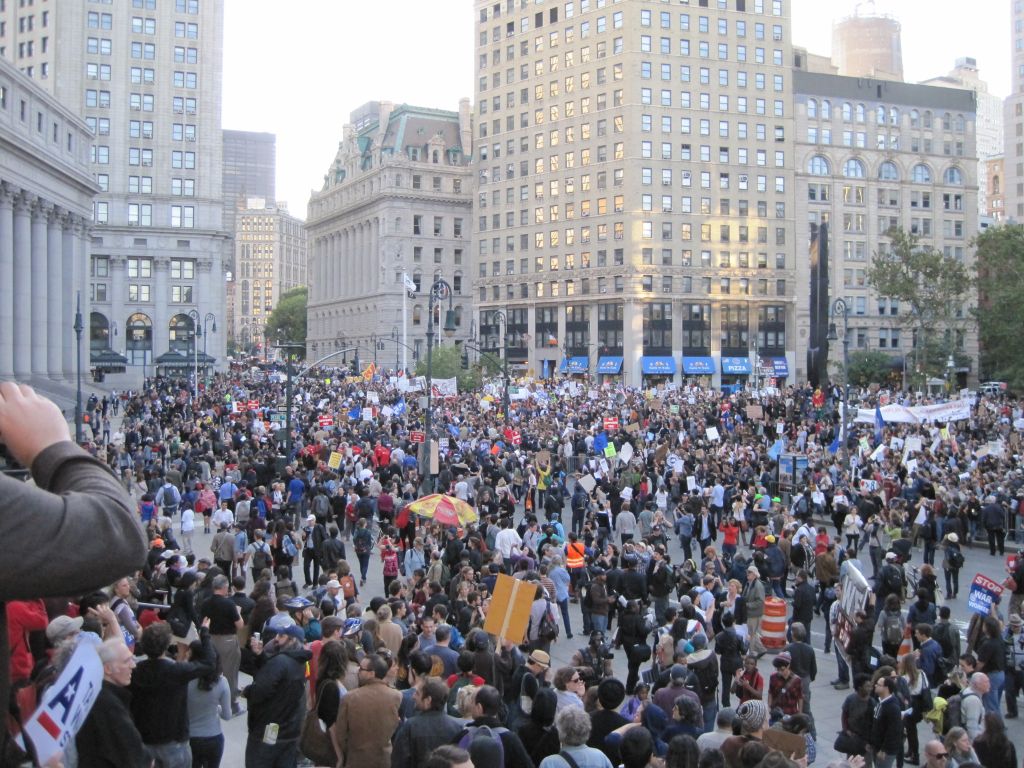
Occupy Wall Street” is a movement that appears to be gaining ground in cities across the country.  It began in New York City in the middle of September and has been growing much like the “Arab Spring” did in Egypt. For the first few weeks, it garnered little attention from the media, even though streets were crowded with protesters.  Some began asking, “Where is the liberal media?” Others began muttering that the lack of media coverage just shows that the corporations own the media, from Fox News to CNN to MSNBC and all shades in between.


Looking back to other citizen protests

Perhaps our comfort level has diminished to the point where people are
once again taking to the streets to state their cause. As one who grew up in the 1960s, I saw the difference that street protests could make – first with civil rights, then with the anti-war movement to end U.S. involvement in Vietnam.  In those days, there was much at stake. Those of us in high school and college knew people who had been drafted into military service, and we knew people who had died in a war that we saw no reason for (in spite of all the hype about the domino theory and communist world dominion).  I became aware of Vietnam when I was in the 4th grade. By the 9th grade, with the war still raging, I was hearing from some of the adults the traditional line about the honor of military service as a way for young men to give to their country. At the same time, having no skills on the athletic field, I failed to see how I could be of service to the military, and I began to wonder how a Baptist might claim conscientious objector status.  I was a senior in high school when I turned 18. Congress had ended the draft that same year, though young men still had to register and carry cards with them at all times (I guess in case the government changed its mind). I had those cards in my wallet for about ten years, and then I decided I could toss them. At any rate, I was quite relieved that the war ended, and thankful for all of those student protests that most people in my hometown had scorned.

By the late 1970s and early 1980s, I was surprised at how many of the “hippies” and protesters of the ‘60s had settled down into comfortable corporate jobs. I saw no pressing desire to right wrongs or end injustice now that our generation was free from the draft and with no conceivable notion that the country could ever get embroiled in such a conflict overseas again. In recent years I have continued to wonder where that spirit went, that desire on the part of young citizens to make things right in society.

Perhaps we were inspired by the Arab Spring, seeing what peaceful protests can do in another country. Perhaps it is a convergence of the social media and growing fear and discomfort on the part of ordinary citizens.  I know that in the 1960s the fear of being drafted into war in a far off jungle, and the uncertainty of what the future held, combined with an unprecedented number of students gathered on college campuses helped to ignite the fires of protest.

Great market numbers, not so great outcomes for people 

For many years now, we have seen Wall Street numbers looking a lot better than what the average person on the street was seeing.  During the boom years of the 1990s, while jobs and the economy were growing, we were losing manufacturing jobs as companies shipped production overseas. There was not a big outcry – for one thing, people enjoyed being able to by goods at lower prices. This was also the time when Walmart, which once had “Buy American” painted on all of their delivery trucks, began getting most of their products from China.

From 2000 to 2008, the market continued to climb upward, while workers’ salaries remained stagnant and their benefits were reduced. Then the financial crisis hit and the market came crashing. Not only was Wall Street bailed out, corporations have continued to post profits while workers have seen no relief from layoffs and unemployment.

Will there be real change ahead?

Perhaps we will see a difference now, with momentum gaining in the Occupy Wall Street movement. (Jonathan Cohn in an article in The New Republic, tells why he is cautiously optimistic.)  Those protests on the streets back in the 1960s and early '70s changed a few things, but many things remained the same. We did have civil rights laws passed, and we did end the draft, but the corporate mind-numbing materialism that was called into question never skipped a beat. Even though we ended the draft, we redoubled our military efforts with a leaner, more efficient "volunteer" military. Consequently, it became even easier to send our young to battle because it never directly affected the population at large. Families were not called upon to offer up their children to fight; only those who made the choice to enter the armed forces had to make the sacrifice. With the Iraq invasion, and the "war on terror," our leaders even told us that the best thing we could do for our country was to just go shopping.

However things turn out, and whatever direction events may take, at least the voice of the people is finally being heard. Someone said that unlike the Tea Party movement, Occupy Wall Street has no big financial backers – and because of its message, will not likely attract any big-monied donors. There is, however, a sense of excitement and hope, similar to that day a quarter-century ago when the people took to the streets in The Philippines to usher in as new day with Corazone Aquino; similar to the sensation of the Arab Spring; and similar to the excitement of the 1960s when a new day was envisioned by the people in the streets. As we know from history, any number of turns can come about. The important thing for us as a people to remember is what Howard Zin stated, "Dissent is the highest form of patriotism." When people publicly let their voice be heard, it means they have hope that we can do better.


*